
Quick Summary
Metal ceiling panels are increasingly being chosen for commercial interiors because they combine durability, aesthetics, and practical performance. But are they genuinely as long-lasting as they appear, or is their durability simply part of their visual appeal?
From moisture resistance and impact protection to maintenance and long-term stability, the reality is more impressive than the myths suggest.
This blog separates common misconceptions from facts to help architects, designers, contractors, and facility teams make informed ceiling decisions.
The Big Question: Do Metal Ceilings Really Last?
A ceiling is more than a finishing element. In commercial spaces, it needs to withstand everyday wear, temperature variations, maintenance activity, moisture, and the demands of a busy environment.
This is where metal ceiling panels have built a strong reputation.
Made using materials such as aluminium and steel, metal ceilings are engineered to provide structural stability while maintaining a clean and contemporary appearance. Their durability makes them suitable for offices, airports, retail spaces, hospitality projects, healthcare facilities, educational institutions, and other high-traffic environments.
Yet several misconceptions continue to surround metal ceilings.
So, let’s separate myth from reality.
Myth 1: Metal Ceiling Panels Are Only About Looks
Reality: Their Appearance Is Just One Part of Their Performance
The sleek appearance of a metal ceiling can certainly be a major design advantage. However, aesthetics are not the primary reason these systems are used in demanding commercial environments.
Quality metal ceiling panels can offer:
- High resistance to everyday wear and tear
- Long-term dimensional stability
- Resistance to moisture and humidity
- Easy maintenance and cleaning
- Compatibility with lighting, HVAC, sprinklers, and other services
- Multiple finishes, colours, patterns, and perforation options
This combination allows designers to achieve a visually refined ceiling without compromising functionality.
In other words, what looks lightweight and elegant can also be engineered for demanding applications.
Myth 2: Metal Ceilings Rust Easily
Reality: Material Selection and Finish Matter
The assumption that every metal ceiling is vulnerable to corrosion comes from treating all metals and finishes as the same.
In reality, the material specification plays a significant role.
For example, aluminium ceiling tiles are naturally resistant to corrosion compared with conventional steel, making them particularly useful in environments where humidity and moisture may be concerns.
Protective coatings and appropriate surface finishes can further enhance resistance to environmental exposure.
This makes aluminium ceiling tiles a practical option for applications where durability, appearance, and maintenance requirements need to work together.
However, product selection should always consider the specific environmental conditions of the project rather than relying on the word “metal” alone.
Myth 3: Metal Baffle Ceilings Are Fragile Because They Look Lightweight
Reality: A Lightweight Appearance Doesn’t Mean Weak Performance
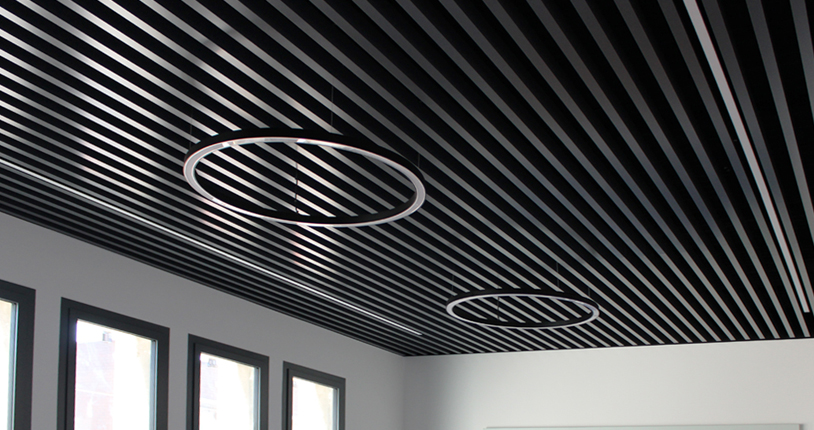
The open, linear appearance of a metal baffle ceiling can create the impression of a delicate architectural feature.
But its visual lightness is not an indication of poor durability.
A metal baffle ceiling uses suspended linear elements that can be engineered for stability while creating an open ceiling aesthetic. This makes it useful for spaces where designers want visual rhythm, accessibility to services, and architectural character.
The system can also support integration with:
- Lighting fixtures
- HVAC components
- Sprinkler systems
- Acoustic treatments
- Signage and other ceiling services
The result is a ceiling that can contribute to both design and functional requirements.
Myth 4: Metal Ceilings Are Difficult to Maintain
Reality: Maintenance Can Be One of Their Biggest Advantages
Commercial interiors require materials that don’t demand excessive maintenance.
Unlike some ceiling finishes that may be difficult to repair or clean, metal ceiling panels are generally designed with practical maintenance in mind.
Depending on the system and finish, individual panels can often be accessed, removed, cleaned, replaced, or repositioned without disturbing the entire ceiling.
This becomes particularly valuable in commercial buildings where maintenance teams regularly need access to electrical, mechanical, and HVAC services above the ceiling.
A well-designed ceiling system can therefore reduce disruption during routine maintenance.
Myth 5: Once Installed, Metal Ceiling Panels Cannot Be Reused or Replaced Easily
Reality: Modular Systems Can Offer Flexibility
One of the less discussed benefits of metal ceiling panels is their modular nature.
Many suspended metal ceiling systems are composed of individual panels, tiles, planks, or linear elements rather than one continuous surface.
This can make targeted maintenance more practical.
If a particular component is damaged, maintenance teams may be able to address the affected area instead of replacing an entire ceiling surface, depending on the system.
This modular approach can support:
Easy access → Targeted replacement → Reduced disruption → Better long-term maintenance
For large commercial projects, that flexibility can become an important part of lifecycle planning.
What Actually Determines the Durability of a Metal Ceiling?
Not all metal ceilings perform identically. Their long-term durability depends on several factors.
1. Material Quality
The grade and thickness of the metal influence strength, stability, and resistance to environmental conditions.
2. Surface Finish
Paint systems, powder coatings, protective treatments, and other finishes can influence appearance retention and resistance to corrosion or wear.
3. Installation Quality
Even a high-quality ceiling system can underperform if it is improperly installed. Correct suspension, alignment, fixing, and detailing are essential.
4. Environmental Conditions
Humidity, temperature fluctuations, chemical exposure, and indoor pollutants should be considered during specification.
5. Maintenance
Regular inspection and appropriate cleaning help preserve both the performance and appearance of the ceiling system.
Therefore, durability isn’t determined by the material alone. It is the result of material + engineering + installation + environment + maintenance.
Metal Ceiling Panels vs. Conventional Ceiling Options
When selecting a ceiling for a commercial interior, durability should be evaluated alongside aesthetics, acoustics, maintenance, accessibility, and lifecycle requirements.
Compared with several conventional ceiling solutions, metal ceiling panels can offer a combination of:
- Long service potential
- Moisture resistance
- Design flexibility
- Easy access to building services
- Replaceable components
- Customisable finishes
- Compatibility with acoustic and lighting requirements
For projects where performance needs to remain consistent over years of occupancy, these characteristics can make metal ceilings worth considering during the early design stage.
Where Do Durable Metal Ceilings Make Sense?
The durability and adaptability of metal ceiling systems make them suitable for a wide range of applications.
- Commercial Offices
- Airports & Transportation Hubs
- Retail & Hospitality
- Healthcare Spaces
- Educational Institutions
In spaces where performance and visual quality need to coexist, aluminium ceiling tiles and other metal ceiling formats can offer practical design possibilities.
The Real Takeaway: Don’t Judge Durability by Appearance
So, are metal ceiling panels as durable as they look?
The answer depends on the specification, product quality, installation, environment, and maintenance but their durability is certainly not just a visual illusion.
The bigger reality is that today’s metal ceiling systems are designed to balance performance, longevity, accessibility, aesthetics, and functionality.
A metal baffle ceiling can introduce architectural rhythm while supporting functional requirements. Aluminium ceiling tiles can provide a lightweight, corrosion-resistant option for suitable applications. And modular metal ceiling panels can simplify maintenance and replacement.
Related Read
Benefits, Applications of Metal Ceilings and Why it’s the Future of Commercial Interiors
Discover how metal ceiling systems combine design flexibility, functionality, durability, and application versatility across modern commercial spaces.
Conclusion
At Tranquil Global, we believe ceiling systems should do more than complete a space as they should contribute to its long-term performance and design intent.
From durable metal ceiling solutions to architectural ceiling systems designed around modern commercial requirements, the right specification can make a difference long after installation.
Looking for a ceiling solution that balances aesthetics, durability, and functionality? Connect with us to explore the right solution for your next project.
FAQs
- Are metal ceiling panels durable?
Yes. Properly specified and installed metal ceiling panels can provide long-term performance, particularly in commercial and high-traffic environments.
- Are aluminium ceiling tiles resistant to moisture?
Aluminium offers good corrosion resistance, making aluminium ceiling tiles suitable for many moisture-prone or humid environments. The complete system and finish should be selected according to project conditions.
- Where can a metal baffle ceiling be used?
A metal baffle ceiling can be used in offices, retail spaces, hospitality, transportation facilities, educational buildings, and other commercial interiors where an open linear ceiling aesthetic is desired.
- Are metal ceilings easy to maintain?
Generally, yes. Many metal ceiling systems are modular and provide access to services above the ceiling while allowing individual components to be cleaned, maintained, or replaced.
- What affects the lifespan of a metal ceiling?
Material quality, coating or finish, installation, environmental exposure, usage conditions, and maintenance practices all influence long-term performance.