
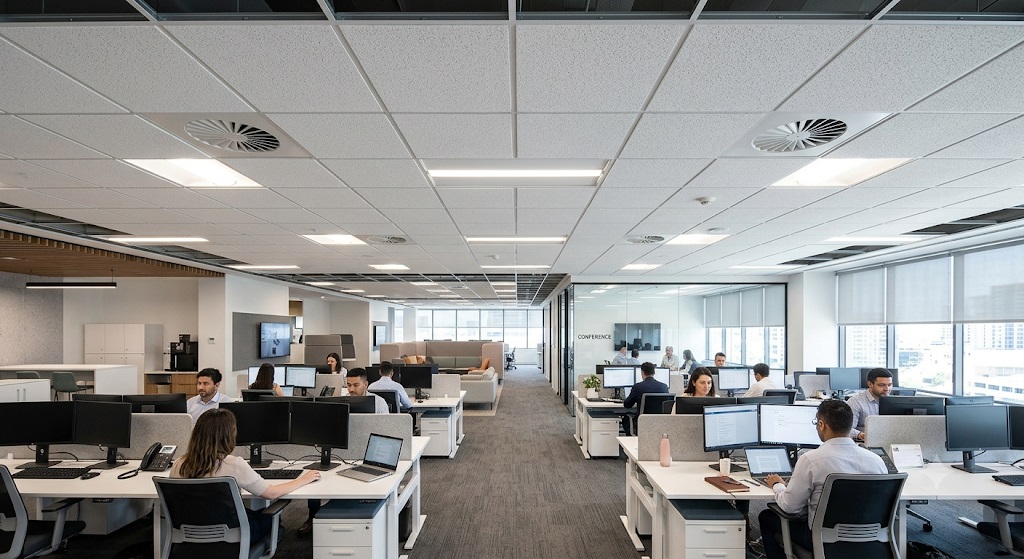
Quick Summary
Office relocations often involve dismantling existing interiors, replacing ceiling systems, and generating significant construction waste. But what if your ceiling could move with you? Acoustic ceiling panels designed for disassembly offer an opportunity to recover, reuse, and reinstall ceiling components in a new workspace. By choosing modular ceiling systems, accessible installation methods, and reusable materials, businesses can make office transitions more cost-efficient and environmentally responsible.
What If Your Office Ceiling Could Move With You?
Office relocations are more than just shifting desks, furniture, and equipment. They often involve dismantling entire interior environments, including partitions, flooring, lighting, and ceiling installations. Unfortunately, many materials that are still in good condition end up discarded simply because they were never designed to be removed and reused.
This is where the concept of Design for Disassembly (DfD) becomes important.
Instead of treating interior elements as permanent installations, DfD encourages architects and designers to select building components that can be easily dismantled, recovered, and reinstalled. Among these, acoustic ceiling panels offer an interesting opportunity to make commercial workspaces more adaptable.
With the right product selection and installation approach, a ceiling installed in one office can potentially find a second life in another.
Design for Disassembly: A Smarter Approach to Office Interiors
Traditional interior construction often prioritises immediate installation requirements without considering what happens when a space undergoes renovation or relocation.
Design for Disassembly changes this perspective by considering the entire lifecycle of building materials.
The approach focuses on:
- Modular construction: Selecting individual components that can be assembled and dismantled independently.
- Mechanical fixing systems: Using accessible fixing methods instead of permanent bonding wherever appropriate.
- Material recovery: Preserving components in usable condition during dismantling.
- Standardisation: Choosing compatible dimensions and configurations that simplify future installations.
- Adaptability: Designing interiors that can accommodate changing layouts and business requirements.
For commercial offices, this means selecting ceiling solutions that deliver acoustic comfort today while offering flexibility for tomorrow.
Why Acoustic Ceiling Panels Are Ideal for Reuse
Ceilings occupy a considerable visual and functional area within commercial interiors. They also play an important role in managing sound, supporting lighting arrangements, and integrating building services.
However, conventional ceiling installations may be difficult to recover without damage.
Well-designed acoustic ceiling panels can offer a more flexible alternative, particularly when they are modular, independently accessible, and installed using reusable suspension systems.
Here is why they deserve consideration:
1. Modular Design Makes Dismantling Easier
Individual panels can often be removed without disturbing the entire ceiling assembly. This allows teams to dismantle specific sections, inspect components, and identify materials suitable for reuse.
2. Reduced Material Waste
When panels retain their structural and acoustic integrity after removal, they may be reused instead of being sent to landfills.
3. Better Flexibility During Relocation
Modular ceiling systems can be adapted to different workspace layouts, subject to dimensional compatibility and installation requirements.
4. Long-Term Resource Efficiency
Reusing suitable ceiling components can reduce the demand for new materials and associated manufacturing resources.
The key is to plan for reuse before the first installation rather than considering it only when relocation becomes necessary.
Acoustic Ceiling Tiles: Small Components, Bigger Sustainability Impact
Not every office requires a complete ceiling redesign when relocating. Sometimes, retaining and repositioning existing ceiling components can be a practical alternative.
This is where acoustic ceiling tiles become relevant.
Their modular format can make them easier to remove, catalogue, transport, and reinstall, depending on the product design and fixing system.
Consider these practical advantages:
- Individual replacement: Damaged tiles can be replaced without removing the complete ceiling.
- Simplified transportation: Standardised tile dimensions can make packing and handling more organised.
- Design flexibility: Different layouts and configurations can accommodate changing workspace requirements.
- Maintenance accessibility: Removable systems can provide convenient access to electrical, HVAC, and other overhead services.
However, reuse is not automatic. Tiles should be inspected for physical damage, contamination, moisture exposure, finish deterioration, and any changes that could affect their acoustic performance.
A sustainable ceiling is not simply one that can be dismantled. It is one that can retain its intended performance after reinstallation.
Acoustic Baffle Ceiling: Designing Open Spaces for Future Adaptability
Modern offices increasingly favour open ceilings, exposed services, and architectural elements that create visual interest without making spaces feel enclosed.
An acoustic baffle ceiling fits naturally into this design direction.
Installed as suspended vertical or linear elements, acoustic baffles help manage sound reflections while creating a distinctive ceiling aesthetic.
From a Design for Disassembly perspective, independently suspended baffles can offer several advantages:
- Individual elements may be removed without dismantling an entire ceiling surface.
- Modular suspension arrangements can simplify maintenance and repositioning.
- Linear configurations can be adapted to different spatial layouts.
- Selected components may be recovered and reused when their condition and compatibility permit.
For example, a company relocating from a conventional office layout to an open collaborative workspace may be able to reconfigure suitable baffle elements rather than automatically replacing the entire ceiling installation.
The final outcome depends on the original system design, suspension infrastructure, ceiling height, and acoustic requirements of the new space.
5 Smart Practices to Make Acoustic Ceilings Reusable
The success of ceiling reuse begins much earlier than the relocation date. Architects, designers, contractors, and facility teams should consider future dismantling during the initial specification and installation stages.
Here are five practices worth incorporating:
1. Choose Modular Ceiling Systems
Prioritise ceiling components that can be individually accessed, removed, and replaced. Standardised dimensions can also simplify future planning.
2. Avoid Unnecessary Permanent Fixings
Where product specifications permit, mechanical fixing and accessible suspension systems can make dismantling easier while reducing the risk of damaging individual components.
3. Maintain a Material Inventory
Record product specifications, dimensions, finishes, installation details, and quantities. This information can help relocation teams identify compatible components for reuse.
4. Plan for Careful Dismantling and Storage
Labels remove panels and tiles, protect their edges, and store them in appropriate conditions. Avoid stacking or handling methods that could cause deformation or surface damage.
5. Evaluate the New Workspace Before Reinstallation
Check whether the recovered components meet the new office’s acoustic, dimensional, safety, and aesthetic requirements. Reinstallation should always follow manufacturer recommendations.
These practices turn ceiling reuse from an afterthought into a planned part of workplace design.
From Office Relocation to Circular Interior Design
The concept of reusable acoustic ceiling panels goes beyond reducing renovation waste. It reflects a broader shift towards circular interior design.
In a traditional linear approach, materials are purchased, installed, used, and eventually discarded. Circular design aims to extend material lifecycles through reuse, recovery, and responsible resource management.
For businesses, this can create several long-term opportunities:
- Lower demand for replacement materials.
- Potential savings on procurement and disposal costs.
- Reduced construction and demolition waste.
- Better utilisation of existing building resources.
- Greater flexibility for future workspace transformations.
Of course, actual savings depend on dismantling, storage, transportation, compatibility, inspection, and reinstallation costs.
Nevertheless, considering the future reuse of acoustic ceiling tiles and an acoustic baffle ceiling during the design stage can help businesses make more informed lifecycle decisions.
The Future of Office Ceilings is Designed to Move
An office ceiling should not necessarily have a single destination.
As businesses grow, relocate, and redesign their workspaces, interior materials need to support changing requirements. Designing for disassembly makes it possible to think beyond the first installation and consider how building components can serve future spaces.
From modular acoustic ceiling panels to reusable acoustic ceiling tiles and adaptable acoustic baffle ceiling configurations, the right ceiling specification can support acoustic performance, design flexibility, and more responsible material management.
The real innovation lies in creating interiors that are not only designed to perform but also designed to evolve.
Related Read
Acoustic Baffle Ceiling Solutions that Speak Style and Performance Together
Discover how acoustic baffle ceiling solutions combine architectural aesthetics, sound management, and functional performance to transform modern commercial interiors.
Design Today. Reuse Tomorrow. Build Responsibly with Tranquil Global.
At Tranquil Global, we believe modern building materials should support evolving architectural needs, functional performance, and responsible design thinking.
Explore acoustic ceiling solutions that bring together sound management, design versatility, and possibilities for adaptable commercial interiors.
Planning a workspace that is ready for tomorrow’s changes? Connect with Tranquil Global and explore smarter acoustic ceiling solutions for your next project.